






July 3, 2000
Aída Hurtado attends White House meeting on Hispanic education
By Jennifer McNulty
When psychology professor Aída Hurtado toured the White House as a graduate
student nearly 20 years ago, it never occurred to her that she would return one day
to discuss national educational policy with the president.
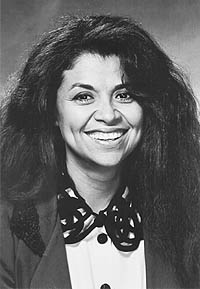 |
| Aída Hurtado Photo: Don Harris |
But that's what she did as part of a daylong White House Strategy Session on improving the achievement of Hispanic students. Hurtado, who helped coordinate the UC-wide Latino Eligibility Task Force in the early 1990s, was one of about 100 scholars, educators, and policy makers from around the country who were invited to attend the session.
As a group, participants discussed five major educational objectives and then met with Bill Clinton in the White House.
"It was amazing," said Hurtado. "The president stayed with us for 2 1/2 hours, which is unheard of, apparently. He usually just stays for the opening remarks or the ceremonial part of an event."
The strategy session was the backdrop for the president's announcement of the formation of the 2010 Alliance, a partnership of corporate, foundation, and community leaders that will seek to double the number of Hispanic students who graduate from college over the next ten years. News of the alliance was covered in the Los Angeles Times, the San Francisco Chronicle, the Chicago Tribune, and the Chronicle of Higher Education, among other papers.
The meeting was convened to identify strategies to reach the following Hispanic student achievement goals:
- Increase access to quality early childhood education
- Eliminate the achievement gap
- Ensure that Hispanic students achieve English language proficiency
- Increase the rate of high school completion
- Increase the college completion rate
"It's kind of sad, actually, because Clinton understands the problems so
well, and he's laying the map and won't be able to carry it out," said Hurtado.
"Somebody else will be elected. Hopefully he'll pick it up."
Hurtado led the panel on eliminating the achievement gap in Hispanic educational
achievement, which she said takes two forms: a high dropout rate and a lack of attention
and resources directed to high-achieving Hispanic students. In 1998, Hurtado said,
the dropout rate for Hispanics aged 16-24 was 30 percent--more than double the rate
for blacks (14 percent) and more than three times the rate for whites (8 percent).
"The emphasis in both research and policy is to focus on why students underachieve,"
she said. "But at the same time, there are also some high-achieving Hispanic
students, and we are doing little to support them. Some high school students who
are doing very well academically know absolutely nothing about how to apply to college,
and that's hurting us in terms of the educational pipeline. And they are ones who
are the most likely to come back and help the rest of the students in their school
districts."
The problem calls for a two-part strategy, said Hurtado: a long-term focus on improving
the performance of K-12 students, and a short-term focus on helping high achievers
move up to the next level of education.
Hurtado said the gathering had historic as well as personal significance. "I
thought I would be somewhat blasé or unimpressed, but it was amazing, and
it was historic, really, to have 100 Hispanic leaders in direct consultation with
the president," she said. The discussion with Clinton, who was well-prepared,
had a natural ebb and flow, said Hurtado. "It was very intimate, not at all
stilted," she added.
"They had gathered the right kind of people, committed people," said Hurtado.
"There was a lot of passion in the room. And these are people who often work
in isolation, feeling like they are the only ones worrying about these things."
After the meeting, participants were invited to tour the entire first floor of the
White House--the Red Room, the Green Room, the Blue Room--and attended a reception
held in the state dining room. Hurtado mentioned a comment Clinton made after the
reporters had left the press briefing.
"He said he thinks he'll be the last non-Spanish speaking president in this
country," she said. Clinton has learned to read Spanish but feels self-conscious
speaking the language, whereas Vice President Al Gore, the Democratic nominee for
president who addressed the meeting via satellite, sprinkled his ten-minute talk
with four or five sentences in Spanish. Republican presidential contender George
W. Bush has been studying Spanish much longer, but Gore's command of the language
is better, said Hurtado.
