|
May 12, 2003
Environmental justice is just common sense to
some, faculty member finds
By Jennifer McNulty
Manuel Pastor remembers the day he proudly told his aunt that he’d
received a $1.7 million research grant for his work on environmental
justice.
|
|
|
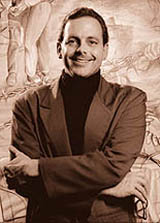
Manuel Pastor Photo: r.r. jones
|
"That’s wonderful, Manuelito," she said, "I’m
so proud of you. But what is environmental justice?"
Pastor explained that toxic-generating facilities appear to be disproportionately
located in minority and poor neighborhoods. His aunt didn’t miss
a beat: "Everyone knows that," she deadpanned.
Pastor, a professor of Latin American and Latino studies at UCSC, shared
the anecdote May 6 during a lunchtime talk about his work as part of
the UCSC Diversity Lecture Series sponsored by the Office of Equal Employment
Opportunity/Affirmative Action (EEO/AA). Diversity and social justice
are the themes of the series, which spotlights faculty research.
Although he is at the forefront of the environmental justice movement,
Pastor conceded his aunt’s point, saying, "I’m involved
with an extensive research project to prove the obvious."
But Pastor and his colleagues have made unparalleled contributions
to the field, improving the scientific credibility of environmental
justice advocates, advancing public policy and public awareness, and
assisting community activists in their pursuit of equity and justice.
Since 1996, when he was on the faculty of Occidental College in Los
Angeles, Pastor has collaborated with Community for a Better Environment
(CBE), the Liberty Hill Foundation, and Occidental to study the distribution
of toxic materials and hazardous waste sites in Los Angeles County.
With $2.7 million in support from the California Endowment, as well
as funds from other agencies, the team has steadily honed in on what
Pastor’s aunt already knew: Facilities that produce or store hazardous
materials are far more likely to be located in poor neighborhoods with
high concentrations of people of color than in affluent, predominantly
white neighborhoods.
By examining the problem at the regional level, Pastor and his team
have been able to demonstrate that disparities do exist, and they have
gone on to develop sophisticated methods to measure the extent of those
disparities and the factors that contribute to them. They have also
documented potential health risks and other consequences, especially
for children, of living near hazardous facilities.
Up to 10 percent of the disparity in academic performance among children
could be caused by environmental hazards on or near school grounds,
according to Pastor’s latest research, which establishes a link
among the environment, student health, and academic performance.
Pastor takes pride in his team’s research results, which have
countered critics who have suggested, among other things, that minorities
and the poor moved into neighborhoods after toxic facilities were established.
"Which came first? I call it the field of bad dreams--build it
and they will come," Pastor said with a wry smile.
But the charge held some merit and needed to be addressed, so Pastor’s
team took it on--and disproved it. A heroic effort by Pastor’s
colleague James Sadd, chairman of the environmental science and studies
program at Occidental College, produced convincing evidence that disparities
in exposure to toxic-producing facilities had worsened over time.
"You’ve gotta be a nerd to love this stuff," said Pastor,
whose presentation was filled with data-rich graphics and detailed maps
of Los Angeles County.
The team also stumbled into an important discovery: Neighborhoods in
transition were the most vulnerable to the siting of new facilities.
Neighborhoods rife with what Pastor calls "ethnic churning"--shifting
from predominantly African American to largely Latino, for example--lack
the tight community networks that typically organize to oppose proposed
toxics facilities.
"Political power matters far more than income," said Pastor.
During a recent presentation before the California Integrated Waste
Management Board, state officials expressed surprise at what Pastor’s
research team had been able to accomplish. "Their own staff had
told them it couldn’t be done," said Pastor, crediting UCSC
graduate Javier Huizar, now a geographic information systems specialist
for UCSC’s Center for Justice, Tolerance, and Community, with the
accomplishment. "Javier was tickled pink when he heard that,"
added Pastor.
The team’s findings also influenced a recent proposal to expand
Los Angeles International Airport and prompted the Los Angeles Air Quality
Management District to tighten its own regulations regarding the acceptable
number of illnesses and deaths associated with new facilities.
Pastor is hopeful that environmental justice will become a "common
ground" issue in California, where Latinos have emerged as the
swing vote and Latino legislators have growing clout in Sacramento.
"A lot of Latinos grew up in these neighborhoods," said Pastor,
recalling his own childhood in La Puente.
"It’s unbelievable how much environmental inequality there
is in this state," he said. "It’s part and parcel of
a system in which opportunities and costs are distributed unequally,
and that’s something we should be changing."
Return to Front Page
|