![[Currents headergraphic]](../../images/currents_header.gif)
July 29, 1999
National Science Foundation approves funding for a UCSC-based Center for Adaptive
Optics
By Tim Stephens
UCSC will lead a multi-institutional partnership to advance the field of adaptive
optics, which promises to revolutionize astronomy and vision science.
The National Science Foundation's governing body,
the National Science Board, approved a proposal today (July 29) to establish a Center for Adaptive Optics at UCSC. The multi-institutional
center will coordinate the efforts of researchers across the country involved in
the rapidly developing field of adaptive optics, which has major applications in
astronomy and vision science.
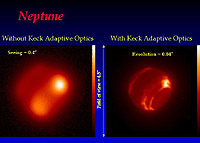 |
Images of the planet Neptune obtained by the Keck II Telescope
with and without the use of adaptive optics (more images)
Photo courtesy Keck Observatory, Adaptive Optics group |
The Center for Adaptive Optics, expected to begin operation in November, is one of
five Science and Technology Centers approved for the National Science Foundation
(NSF) this year. NSF program guidelines allow for financial commitments of up to
$20 million over five years for each center, but final awards under these cooperative
agreements are subject to negotiations between NSF and the lead institutions.
UCSC's 27 partner institutions in the Center for Adaptive Optics will include UC
Berkeley, UC San Diego, UCLA, UC Irvine, the University of Chicago, the California
Institute of Technology, the University of Rochester, the University of Houston,
Indiana University, Lawrence Livermore National Laboratory, and 17 other national
laboratory, industry, and international partners (complete
list).
Adaptive optics is a method to actively compensate for changing distortions that
cause blurring of images. It is used in astronomy to correct for the blurring effect
of turbulence in the earth's atmosphere and in vision science to compensate for aberrations
in the eye that affect vision and impede efforts to study the living retina.
An adaptive optics (AO) system requires several highly advanced technologies, including
precision optics, sensors, and deformable mirrors, plus high-speed computers to integrate
and control the whole system. Basically, the AO system uses a point source of light
as a reference beacon to measure precisely the distortion created by the atmosphere
(or by internal imperfections and fluids in the eye); then an "adaptive optical
element," usually a deformable mirror, is used to cancel the effect by applying
an opposite distortion. For astronomy, the system must measure atmospheric distortion
and apply a correction hundreds of times per second.
The director of the Center for Adaptive Optics will be Jerry Nelson, professor of
astronomy and astrophysics at UCSC, who designed the twin Keck Telescopes at the
W. M. Keck Observatory in Hawaii and is a leading expert on the technology of large
telescopes, optics, and instrumentation.
Chancellor Greenwood said the center is a natural fit for the UCSC campus, which
is also headquarters for UC Observatories/Lick Observatory (UCO/Lick). The NSF funding
will enable UCSC to construct a new building on campus to house the Center for Adaptive
Optics. Construction of the building, to be located in the campus's "Science
Hill" area, is expected to be completed by fall 2000.
"Our astronomers are leaders in the development and use of new technologies,
and adaptive optics is an exciting interdisciplinary field that will benefit tremendously
from the collaborations and synergism fostered by an NSF Science and Technology Center,"
Greenwood said.
First-generation adaptive optics systems have been installed on the 3-meter Shane
Telescope at Lick Observatory and the 10-meter Keck II Telescope in Hawaii. Although
these systems have yielded impressive results, AO is not yet in routine use, Nelson
said.
"Adaptive optics is enormously complex, and to bring this technology to maturity
and make AO systems practical tools for scientists will require a coherent national
program that brings together scientists and engineers with diverse areas of expertise,"
Nelson said.
"As far as we've come in adaptive optics, we've only just begun to realize its
potential," said Joseph Miller, director of UCO/Lick.
For astronomers, adaptive optics can give ground-based telescopes the same clarity
of vision that space telescopes achieve by orbiting above earth's turbulent atmosphere.
"This is the gateway to an unimaginable future," said UCSC astronomer Sandra
Faber. "Adaptive optics makes the Keck Telescope 20 times sharper, so it's like
bringing the universe 20 times closer," she said.
With adaptive optics, the Keck Telescopes, currently the largest optical telescopes
in the world, can achieve four times the resolution of the Hubble Space Telescope
in the near-infrared wavelengths, noted Claire Max, who heads the group at Lawrence
Livermore National Laboratory (LLNL) that helped developed the AO systems for the
Keck and Lick Observatories.
Max said she expects most of the large ground-based telescopes will have AO systems
within the next few years. Very few astronomers, however, have any experience using
adaptive optics, she said. "One goal of the center is to bring adaptive optics
to the broader astronomical community through conferences and workshops," said
Max, who is director of university relations for LLNL.
In vision science, adaptive optics has made it possible to obtain images of the living
human retina with unprecedented resolution, enabling researchers to see the individual
receptors involved in vision, said David Williams, director of the Center for Visual
Science at the University of Rochester. Williams and his coworkers recently used
AO to obtain images showing how the three types of cones involved in color vision
are arranged in the human retina.
"We've also just begun to explore the potential of adaptive optics for looking
at retinal diseases," Williams said. "In addition, by measuring aberrations
in the eye better than before, we may be able to develop better contact lenses or
better laser surgery procedures. So this technology has a lot of potential for improving
vision."
While astronomy and vision science use similar AO technology, they have different
needs for future technology development, Nelson said. "In astronomy, our needs
are for increasingly complex and sophisticated systems, whereas in vision science
the emphasis is likely to be on miniaturization and creating more human-friendly
systems for use in health care," he said.
The Center for Adaptive Optics will provide the sustained effort needed to bring
adaptive optics from promise to widespread use. The center will conduct research,
educate students, develop new instruments, and disseminate knowledge about adaptive
optics to the broader scientific community. The center will concentrate on astronomical
and vision science applications and will reach out to scientists in other fields
to share technologies.
The center will also develop a range of science education and outreach programs,
which will be coordinated with UCSC's existing programs through the campus's Educational
Partnership Center. Partnerships are planned with local public schools and with institutes
such as the Chabot Observatory and Science Center in Oakland, which operates a planetarium,
after-school science programs for youth, training for teachers, and summer science
camps. In the Chicago area, the center will work with similar programs through the
Adler Planetarium and the Yerkes Observatory.
"Everyone involved in the center will devote some of their time to education
and outreach programs," Nelson said.
Industry partnerships will be important for developing practical new devices and
implementing adaptive optics applications in health care and other fields. Bausch
and Lomb, ERIM International, and Lucent Technologies will be among the center's
industrial partners.
To the Currents home page
To UCSC's home page