




April 24, 2000
Anthropologist chronicles stunning transformation of Christian fundamentalism
By Jennifer McNulty
Over the years, anthropologist Susan Harding fielded a lot of questions about her
work on Jerry Falwell and American Christian fundamentalism in the 1980s, but one
in particular resonated throughout her research: "Are they dumb, stupid, or
just plain ignorant?"
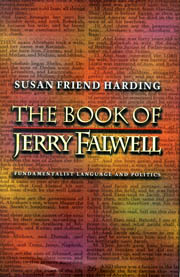 |
The result of that years-long effort is Harding's new book, The Book of Jerry Falwell: Fundamentalist Language and Politics (Princeton, N.J.: Princeton University Press, 2000). Despite her colleague's swift dismissal of Bible-believing Christians, Harding found that Jerry Falwell and his fellow preachers masterminded the stunning transformation of "stay-at-home" Christian separatists into a daunting force that has forever changed this country's cultural and political landscape.
"For most of the 20th century, fundamentalists were in self-imposed exile," said Harding. "They were separatists who shunned the secular world as profane and corrupt."
But the 1980s marked a dramatic reversal, during which the definition of "good Christian" became synonymous with "engagement" at all levels of secular society, including politics, which was perhaps the most visible--though far from the only--landscape to be transformed by the shift.
"They weren't merely interested in affecting conventional politics, but in altering all of society," said Harding. "One preacher I spoke with used words like 'infiltration' and 'guerrilla warfare' when he described the church's goal of transforming society."
Indeed, believers were urged to enter professions like teaching and health care, where they could fight for the teaching of creationism and against the growing euthanasia movement. Nurses were called on to "blow the whistle" on doctors performing late-term abortions. Believers were encouraged to join the entertainment industry where they could influence the content of movies and television shows.
Far less visibly than high-profile leaders like Jerry Falwell and Jimmy Swaggart, thousands of preachers around the country mobilized their congregations, and the results have been dramatic, said Harding. "This was not a one-time episode," emphasizes Harding. "This shift in engagement has had a powerful and lasting impact on all of American society."
Falwell and other leaders, including televangelists like Jim Bakker, received widespread media exposure in the 1980s that contributed to an impression of unity and size that did not accurately reflect Christian fundamentalism at the time, said Harding. Those impressions scared the opposition, but more importantly, they helped Christians see themselves as a national force before they had actually become one. By the late 1980s, following a wave of scandals that washed over several prominent fundamentalist leaders, media coverage died down and liberals began to dismiss born-again Christians as off-center oddities. Though their visibility has faded, nothing could be further from the truth, said Harding.
"As founder of the Moral Majority, Falwell urged his followers to become full participants in public and political discourse," said Harding. "In doing so, he and his colleagues transformed American fundamentalists from a group of marginal separatists into a vocal political and cultural force. With 50 million Americans describing themselves as born-again Christians today, fundamentalists make up one of the most powerful forces in our country."
In her book, Harding examines the complex changes in the language of the fundamentalist movement, focusing on the words of preachers and leaders in sermons, speeches, pamphlets, books, television broadcasts, and conferences. It was through their use of the Bible's language, Harding asserts in the book, that Falwell and his co-pastors molded their churches into "a living sequel to the Bible."
"Bible-based language is very persuasive, and it produces effects," said Harding, who visited Falwell's ministry in Lynchburg, Virginia, a half-dozen times during the 1980s. By studying the complexity and creativity of "born-again language," Harding was able to reveal the social force and consequences of born-again language.
"Falwell and his colleagues used language in a way that enabled believers to understand their cultural and political transformation in the 1980s as if it flowed directly from the Bible and therefore from God," said Harding. "Language is the medium through which born-again Christians are formed and reformed, and the reformation that took place in the 1980s will resonate in our society for a very long time."
