







March 27, 2000
UCSC installation artist sets her sites around the globe
When it opens in the spring, the new National Government Center in downtown Saitama, Japan,
will become one of the busiest pedestrian corners of the world, with some 50,000
people crossing the plaza each day. As they traverse the area, inevitably, many of
those people will raise their wrists and glance downwards to check on the time.
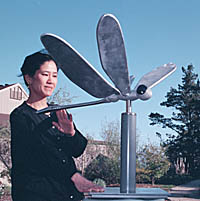 |
| Artist Nobuho Nagasawa next to a working model of a 12-piece installation
that will soon hover over the new McEnery Children's Park in downtown San Jose. Photo: Barbara McKenna View more art pieces |
Nagasawa's project, commissioned by the Ministry of Construction in Japan, covers 15,700 square feet of the plaza with an iridescent lunar calendar that is periodically sprayed by a mist fountain.
"The genesis of this proposal was to question the concept of people's perception of time and space in the contemporary urban world," said Nagasawa, an assistant professor of art at the University of California, Santa Cruz.
Nagasawa explains that, "Throughout ancient civilizations, the moon was one of the important factors used to measure time. One of the ancient customs that still remains in the Japanese calendar is a day to observe the moon. However, contemporary urban Japanese people, who only look at their wristwatches, have forgotten how to experience time as they would in this ritual."
The fountain that Nagasawa incorporates in her project evokes another ancient Japanese method of timekeeping, one that Nagasawa says dates from the seventh century. "Water, dripping from a series of vessels, was used to keep track of time," she explains. "I chose to use the element of water in the form of a mist fountain to add another dimension to the perceptual experience of the plaza."
Images of the 28 phases of the moon are set into the ground in a pattern signifying the cycle of the moon. The material used to make the moons includes a glow-in-the-dark phosphor that maintains an unearthly blue glow long into the night with a material developed and manufactured especially for this project. "As dusk approaches, the plaza will become a magic carpet, as blue light glows from within the moon, while luminescence rises from the mist fountain," she said.
Time is a theme of ongoing interest to Nagasawa, whose works have been exhibited around the word, from Prague, Czech Republic, to Aachen, Germany; to Mexico City; to New York and Los Angeles.
Nagasawa describes her pieces as "site-specific" installations because they reflect the history and environment of their place. She never conceives an idea until she has visited a site and then, through her hands, she builds works that are part history, part poetry, and undeniably stunning.
Her piece in Prague, a replica of the 12th-century Charles Bridge in sandbags and barbed wire, invoked multiple layers of the region's history, emphasized by a Bohemian crystal hourglass placed alongside the piece. (The first person to turn the hourglass when the piece was installed in 1993 was Czech Republic President Vaclav Havel.)
A light sculpture she created for a station on Los Angeles's Metro Red Line evokes the history of the area, which served as an arrival area for immigrants much like Ellis and Angel Islands. Nagasawa conceived a light sculpture for the site as a symbol of the safe end of a journey. When the station is constructed, modern commuters may see the light as a friendly beacon as well--a signal of their homecoming. An award-winning work for an L.A. library recalls the nation's history of book censorship and at the same time, with hand-carved stools spelling out "imagination," pointed to the positive function of a library to society.
Another piece due for completion this spring is a collaboration with a landscape artist for the McEnery Children's Park in downtown San Jose. Nagasawa designed wind vane sculptures in the form of insects. The idea, she said, was inspired by the park's proximity to the Guadalupe River. "These insects, dragonflies in particular, are important monitors of river ecology," she explains. "And the dragonfly is considered to be one of the most ancient species, having survived since the Jurassic period." Nagasawa hopes the sculpture will "reawaken our relationship to the wind, sun, and water--the fundamental source of life in this urban park. It also celebrates the Guadalupe River that gives life to the flora and fauna and the people of San Jose."
Through a commission from the San Francisco Arts Commission, Nagasawa has been working with a landscape architect on improvements to an 860-foot-long public access area along the Islais Creek near the I-280 freeway in San Francisco. "The design recognizes the work of indigenous peoples as well as the more recent waterfront industries that shaped the current identity of the site," she explained. Nagasawa discovered that the site once supported shipbuilding and coconut-refining industries. To evoke these themes, she has created a suspended-steel sculpture outlining the form of a ship. That project is due to be completed sometime this year.
Another project due to be completed this year is in the City of Stockton. Derivi Castellanos Architects are overseeing an innovative overhaul of the Arch Road and Highway 99 interchange, envisioned as a gateway to the city. Nagasawa has been commissioned to create the artistic vision for the project, which includes a sound wall, retaining wall, and freeway interchange bridge. Wanting to evoke the industrial and agricultural history of Stockton, as well as the current function of the space, Nagasawa developed a collage of abstract patterns inspired by various transportation modes--historic wagon wheels, tractors, contemporary industrial tools and parts, all abstracted and repeated.
These are only some of the many pieces the artist is immersed in over the next few years. Other projects are in the works in San Francisco, Seattle, and Japan. Nagasawa will also be featured in a soon-to-be-released book titled "Contemporary Artists in the Bay Area," compiled by editors from the City of Los Angeles and San Jose Cultural Affairs Departments.
