|
January 20, 2003
Campus taps new breed of electric cars
By Louise Donahue
There are some new cars cruising through campus these days, and they're
real gems. To be more specific, they are GEMs, vehicles made by Global
Electric Motorcars, a DaimlerChrysler company.
|
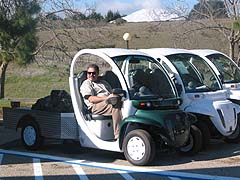
|
| TAPS director Wes Scott, above, has been
impressed with the usefulness and low cost of the GEM electric cars.
Photo: Louise Donahue |
DaimlerChrysler donated five cars to UCSC as part of an overall gift
of 184 GEM vehicles to the University of California.
"I think it's really going to catch on. A lot of people are very
excited about it," said Wes Scott, director of Transportation &
Parking Services, or TAPS.
Scott was so impressed with the donated cars that TAPS bought five
others, and may buy more. A special state contract price of roughly
$2,000 each (for campus use only) makes the vehicles a good value compared
with the cost of gasoline-powered vehicles.
GEM cars are offered in two- and four-seat configurations, but UCSC's
cars are all two-seaters with a 70-inch by 48-inch flatbed for cargo.
UCSC's cars come without doors, but those wanting doors may order them.
Scott explained that the cars are classified as "low-speed vehicles,"
meaning they can be driven on any streets with a posted speed limit
of 35 mph or less. Beginning in 1998, the federal government created
a new category to cover such cars, also known as Neighborhood Electric
Vehicles. Cars in this category must include safety features, such as
headlights, turn-signal lamps, an emergency brake, windshields, seat
belts, and vehicle identification numbers.
When fully charged, the cars can travel 35 miles at speeds of up to
25 mph. (On a test drive from the base of campus to the East Remote
parking lot, the car went 20 mph uphill and reached 27 mph downhill.
The GEM has a stable feel, with a ride similar to that of a golf cart.
The ride is smooth and quiet.)
So far, the cars have been ordered for OPERS, the Bay Tree Bookstore,
Environmental Health and Safety, groundskeepers, and other units. Various
electric vehicles have been tried at UCSC, Scott said, but the GEM cars
are the first ones he feels he can endorse. The small electric vehicles
in use on campus prior to the GEM cars' introduction have been returned.
"They were cute, but they didn't have the functionality,"
he said.
Scott said maintenance costs on the GEM cars are low, in part because
there are so few moving parts. "It's just an electric motor."
They can be plugged into any standard 110-volt outlet with an extension
cord, and take six to eight hours to be fully charged.
In addition to its other attributes, the GEM cars have another big
advantage at UCSC: they don't need to find a space in a campus parking
lot. Scott said the GEM cars are small enough to be parked at loading
docks or under the eaves of buildings, as long as they don't block fire
lanes.
Campus departments interested in leasing or purchasing a GEM car should
contact TAPS.
Additional information on the vehicles is available online from Global
Electric Motorcars LLC and other
sources.
Return to Front Page
|