|
    
|
June 3, 2002
Book shows that debates over the role of films are nothing new
Questions posed almost 100 years ago by German psychologist
By Ann M. Gibb
Are movies art, or entertainment? Does watching violent films encourage violent behavior
in teenagers? Should movies be censored?
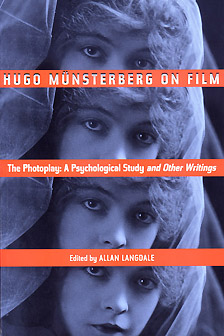 |
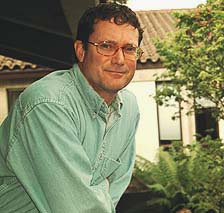
| A new book, above, by art historian Allan Langdale, below, collects all the writings
on film by Hugo Münsterberg, an early film theorist. Photo
of Langdale: Angelica Farber. |
 |
These questions are being debated today, but they were also posed nearly 100 years
ago by Hugo Münsterberg, a German psychologist who came to America and fell
under the enchantment of the new medium called the "photoplay."
The first complete collection of his writings about movies has recently been published
in Hugo Münsterberg on Film (Routledge, 2002), edited and with an introduction
by UCSC lecturer in art history Allan Langdale.
"Münsterberg's book The Photoplay, which was published in 1916,
is regarded by many as the first serious piece of film theory," said Langdale
about the centerpiece text in the new book. "But as I was preparing to teach
a film course, I discovered it had been out of print for decades, and that used copies
were going for $65."
Langdale's new edition has additional writings on film by Münsterberg, including
a 1916 interview with him by a representative of Paramount Pictures, an article on
The Photoplay by Münsterberg's daughter, and extensive endnotes.
In collecting Münsterberg's work, said Langdale, "I strove to create
a one-stop source for Munsterberg's writings on film, useful for scholars of film
theory, film history, and even psychologists."
At first glance Münsterberg seems an unusual candidate for groundbreaking writings
about movies. An academician and a pioneer in industrial and experimental psychology,
he began teaching at Harvard University in 1892. In his essay "Why We Go to
the Movies," Münsterberg confesses that he felt it was "undignified
for a Harvard professor to attend a moving picture show." But on a trip away
from Boston he took a chance and saw the film Neptune's Daughter, an experience
that converted him into a champion of the film medium.
"Münsterberg's interests prepared him in interesting ways to consider the
film medium," said Langdale. Münsterberg was fascinated by illusions pertaining
to movement and perception, and was attracted to film as a medium in which the sensation
of movement exists only as an illusion in the mind of the viewer. As a psychologist,
he researched and wrote about memory, suggestion, and emotion, and was intrigued
by the combined function of these elements in films.
Münsterberg believed in the power of the performing, visual, and literary arts
to improve both the aesthetics and morality of Americans. His hypothesis that the
new medium of film held the potential for improving society will be familiar to contemporary
audiences experiencing the promise and the challenges of the Internet and other digital
media.
"Surely I am now under the spell of the 'movies,'" Münsterberg wrote.
His enchantment was tragically short lived. Münsterberg died from a cerebral
hemorrhage in 1916, about two years after seeing his first movie, and before the
advent of synchronous sound and color movies. Hugo Münsterberg on Film
captures his brief but important career as a film theorist commenting on the creation
of a new art form.
Return to Front Page 
|
|