|
   
|
January 14, 2002
Habitable worlds unlikely in nearby planetary system, astronomers find
By Tim Stephens
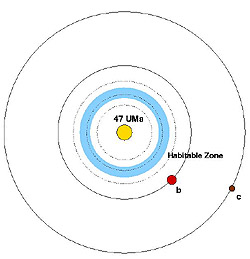 |
This figure shows the relative scale of the orbits of the two planets ('b' and
'c') orbiting the star 47 Ursae Majoris. The sizes of the planets are not to scale
with the size of the central star. The habitable zone around 47 UMa is shown as a
light blue band. For comparison, the orbital radii of Venus, Earth and Mars are shown
as dotted lines. A series of numerical simulations have shown that any terrestrial
(Earth-size) planets in the 47 UMa system are likely to lie closer to the star than
the habitable zone.
Image: Gregory Laughlin |
Of all the extrasolar planetary systems detected by astronomers in recent years,
the star 47 Ursae Majoris and its known companions, two Jupiter-sized planets, is
the one that most closely resembles our own solar system.
Computer simulations now show, however, that Earth-sized planets are unlikely
to form in the so-called "habitable zone" of 47 Ursae Majoris (47 UMa).
The new findings were reported last week at the American Astronomical Society meeting
in Washington, D.C., by Gregory Laughlin, an assistant professor of astronomy and
astrophysics at UCSC; John Chambers of NASA Ames Research Center; and Debra Fischer
of UC Berkeley.
Planet hunters have detected nearly 80 planets orbiting nearby stars, but most of
them have elongated, or "eccentric," orbits. The two planets around 47
UMa, which is located in the Big Dipper constellation, have nearly circular orbits,
like those of Earth and other planets in our solar system. Their orbits are farther
from the star than Mars is from the Sun, but closer than Jupiter.
The striking similarity between the pair of planets orbiting 47 UMa and the Jupiter-Saturn
pair in our solar system led Laughlin, Chambers, and Fischer to investigate whether
smaller, Earth-sized planets could have formed and survived in the habitable zone
around 47 UMa. The habitable zone is the region surrounding a star where liquid water
could exist on the surface of a planet--a region roughly equivalent to the space
between the orbits of Venus and Mars in the solar system. Earth-like (or "terrestrial")
planets are too small to be detected with present-day planet-hunting techniques.
The researchers performed a large set of computer simulations and found that Earth-sized
planets have a very hard time forming in 47 UMa's habitable zone. The combined gravitational
forces of the two large outer planets conspire to prevent Earth-sized planets from
building up in orbits where temperatures are clement, Laughlin said.
"Our simulations suggest that terrestrial planets can readily form around 47
UMa in orbits that are roughly half the size of Earth's orbit," he said. "Out
in the habitable zone, an Earth-sized planet can survive in a stable orbit, but it
is very hard to see how such a planet could be assembled."
During the formation of a planetary system, terrestrial planets such as Earth or
Mars are believed to form from successive collisions of small asteroid-sized bodies
which stick together to form progressively larger bodies called "planetary embryos."
This process is known as planetary accretion. It is likely that our solar system
went through such a phase, in which hundreds of moon-sized planetary embryos emerged
from numerous collisions among a much larger number of small precursor bodies, Laughlin
said.
The researchers used a highly efficient computer program developed by Chambers to
simulate the further development of planetary accretion from this stage. A typical
calculation followed the long-term evolution of a swarm of 280 moon-sized planetary
embryos in the presence of the two giant planets orbiting 47 UMa, and spanned a time
frame of 50 million years near the beginning of 47 UMa's history. The simulations
showed that embryos starting in the habitable zone tend to jostle each other into
orbits where the gravitational tugs from the two outer planets either fling the embryos
from the system or drive them into the star itself. On the other hand, the embryos
that started inside the habitable zone were always able to consolidate into several
Earth-sized planets, all having an orbital period of half a year or less.
At the end of several simulations, a single tiny survivor was left in the habitable
zone. In other simulations, the habitable zone was entirely cleared, Chambers said.
The survival of isolated remnant embryos in the habitable zone of 47 UMa suggests
a possible parallel to the asteroid belt in our own solar system. Within the asteroid
belt, many orbits are stable, but certain locations within the belt contain unstable
"resonances" where objects experience rapid orbital instability. Planetary
embryos tend to scatter each other into these unstable zones, leaving behind a smattering
of survivors--the asteroids--which are much smaller than the terrestrial planets.
"Because these two giant planets orbiting 47 UMa are more than twice as close
to the star as Jupiter and Saturn are to the Sun, the 47 UMa system looks like an
overweight, scaled-down version of the solar system. Any terrestrial planets or an
analogue to the asteroid belt around 47 UMa would likely be about twice as close
to the star as well," Chambers said.
The researchers' assessment of habitable planet formation was part of a larger theoretical
investigation of the two planets orbiting 47 UMa, in which the team narrowed the
range of possible orbital configurations that the planets might occupy. They also
showed that the two outer planets have undergone very little orbital modification
since their formation. The research was funded by the NASA Origins of Solar Systems
Program.
Return to Front Page 
|
|