







July 31, 2000
New dean of humanities named at UC Santa Cruz
By Barbara McKenna
An internationally respected professor of English and literature has been appointed
dean of the UC Santa Cruz Humanities Division.
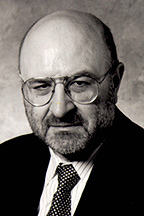 |
| Wlad Godzich |
Named to the position is Wlad Godzich, who comes to UCSC from the University of Geneva in Switzerland, where he was professor of English and comparative literature, chair of the Emergent Literatures program, and a professor in the university's Graduate Institute of European Studies. His appointment as dean at UCSC is effective as of August 7.
Godzich succeeds Jorge Hankamer, a professor of linguistics, who had served as dean since 1995.
The author of several critically acclaimed books on literature and language, Godzich has held visiting professorships at universities around the world, from Brazil to South Africa to Canada to Spain. His experience in academic administration goes back to 1961 and includes the positions of director of the Columbia University-Barnard College program in Paris; and, at the University of Minnesota, director of the Office of Research Development, director of the comparative literature program, director of the Center for Humanistic Studies, and coordinator of UM's international program in Dakar, Senegal. He also served as director of the Department of English while at the University of Geneva. He has organized more than a dozen international conferences during his career.
Godzich is a member of the editorial boards of several journals and has authored a number of books, including The Culture of Literacy (Harvard University Press, 1994) and a new book, "Leituras de Walter Benjamin," which is forthcoming. He is editor of the book series Theory and History of Literature, published by the University of Minnesota Press and the Manchester University Press.
In discussing his new appointment, Godzich said, "Everywhere around the world very serious questions are being raised about the future of the humanities and the nature of the humanities. I think this is something that practicing humanists must address directly at the administrative level as well as the intellectual level. Those of us in the field must dedicate ourselves to renewal and renovation of humanities. I think it is fitting that a new attempt at reinventing humanities be attempted at UCSC, which has been considered a pioneering school since its inception."
With the rush of technological advancement in such areas as genetic engineering, communications, and medicine, society is facing a quagmire of ethical and philosophical concerns. Godzich explains that the humanities will play a vital role in not only addressing, but identifying, these issues.
"We need to impress on all of contemporary society that the notion of the
human must be in the forefront of our concerns," Godzich said. "But this
notion of the human is not one we can continue to derive from traditional sources
of humanism--we are entering an age where human beings will be manufacturing human
beings and we need to think very hard about who we are and who we want ourselves
to be. The role of the humanities in this new age is to provide answers and, also,
find the questions to address the future of humanity, our identity, our ethics, the
use of new technologies, and the role of culture and diversity in new societies."
Godzich says that one goal for his administration at UCSC will be to foster collaborative
efforts. "I think that much of research that has been done in the humanities
has been carried out in an individualistic mode, and one of the things I hope to
promote at UCSC is a new way of conducting research in a genuinely collaborative
way--a way in which undergraduate and graduate students and junior and senior faculty
will form research teams. Rather than break down the humanities by discipline, I'd
like to foster an approach to the humanities as a series of issues we examine together."
Godzich was one of a handful of candidates selected by UCSC's Humanities Dean Search
Committee to be put forth for consideration by Academic Provost and Executive Vice
Chancellor John B. Simpson.
Stevenson College provost and professor of history Tyler Stovall was a member
of that committee. According to Stovall, who also chairs the History Department,
"Godzich stood out because he had a wealth of administrative experience and
he also had wonderful experience as a scholar. He came across as a very brilliant
and vibrant intellectual force. We felt he had some strong ideas about reaching out
to the broader community--both academic and nonacademic--about the importance of
the humanities."
Stovall also noted that, "As someone coming from outside the University of California
system, Professor Godzich seemed to have a good command of the procedures of the
system. The sense we had was that he would be able to bring in fresh perspective
but also an understanding of how procedures work here. We were impressed by the fact
that he had very strong and definite ideas but was also very willing to listen. On
top of his administrative contributions, we felt he'd be a wonderful addition to
the faculty here."
