October 18, 2004
Laboratory test of evolutionary theory
confirms the importance of connections between populations
By Tim Stephens
Researchers studying the evolutionary dynamics of bacteria
and viruses in bubbling glass tubes have confirmed an evolutionary
theory of central importance to ecologists studying more familiar
flora and fauna in the wild.
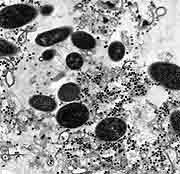
In this electron microscope image,
the large dark shapes are E. coli bacteria and
the small black dots are the bacteriophage T7 viruses
that infect them. Photo: B.
Bohannan
|
The theory predicts how the movement of individuals between
different populations of a species influences evolutionary change
in those populations, particularly with respect to coevolutionary
interactions between species.
This is an important issue in understanding the long-term effects
of the increasing fragmentation of natural habitats due to human
activities. Many ecologists believe that fragmentation of the
natural landscape, by separating communities of organisms that
had been connected, has the potential to alter the evolutionary
processes that enable organisms to adapt to changing local conditions.
This study provides hard evidence to support that view.
The study, published in the October 14 issue of the journal
Nature, looked at the coevolution of a common type of
bacteria, Escherichia coli, and a virus that infects
it, called bacteriophage T7. The researchers were able to track
adaptations that arose in both bacteria and virus populations
and show that the pattern of adaptations depended on both the
environment in which the organisms were growing and the spread
of genes between different populations.
Ecologists use the term "gene flow" to describe the
spread of genetic variants that accompanies the movements of
individuals. This study provides the first direct empirical
evidence that gene flow across a heterogeneous landscape can
alter the dynamics of coevolution.
"By working with microbes that go through about ten generations
per day in the laboratory, we were able to track evolutionary
changes through time and answer questions that previously had
only been addressed theoretically," said Samantha Forde,
a postdoctoral researcher at UCSC and first author of the paper.
Forde's coauthors are John Thompson, professor of ecology and
evolutionary biology at UCSC, and microbial ecologist Brendan
Bohannan of Stanford University. Forde conducted the study as
a postdoctoral researcher in Bohannan's lab at Stanford.
According to Thompson, the history of evolution and the diversification
of life on Earth is fundamentally a history of the evolution
of species interactions, or coevolution. Thompson is a leading
proponent of the geographic mosaic theory of coevolution, which
emphasizes that every species is a collection of genetically
distinct populations that are linked across landscapes, resulting
in complex geographic mosaics of species interactions that can
evolve differently in different locations.
"We have a pretty solid theoretical framework for explaining
coevolutionary interactions between species and how coevolution
organizes biodiversity through networks of interactions across
landscapes," Thompson said. "These experiments are
one step in actually translating that theory into predictive
analyses of natural populations."
The experiments used a simplified system in the laboratory
to test the predictions of the theory. The basic coevolutionary
dynamics of E. coli bacteria and bacteriophage T7 are
well known. When T7 is introduced to a population of E. coli,
the bacteria soon evolve resistance to the virus. The virus,
in turn, evolves to attack the resistant bacteria, and then
the bacteria are able to evolve a second level of resistance
to the more potent form of the virus.
According to Bohannan, microbial experimental systems have become
increasingly popular in ecology, due in part to the degree of
control they offer and their relative simplicity. "Coevolutionary
change happens rapidly in these communities and can be easily
detected. Furthermore, the genes underlying these coevolutionary
changes are known and accessible to study," Bohannan said.
Forde set up microbial communities of bacteria and viruses with
different nutrient levels in a series of chemostats--glass culture
tubes that provide nutrients and oxygen and siphon off wastes.
In one set of chemostats the communities remained isolated from
one another. In another set, Forde periodically made a series
of transfers between communities, sucking up a pipette full
of bacteria and viruses from one chemostat and adding it to
the next one, and so on down the line. She also periodically
analyzed the populations of bacteria and viruses in each community.
"I created in the laboratory a fragmented landscape with
communities of microbes growing in different local environments,
and then I looked at what happens over time when the fragments
are isolated and when there is gene flow between fragments,"
Forde said.
In the isolated communities, resistant bacteria--and viruses
able to overcome that resistance--evolved more rapidly in the
chemostats with high nutrient levels than in those with low
nutrients. That's because the microbes multiplied more rapidly
in the high-nutrient environment, resulting in more opportunities
for favorable mutations to arise.
The dynamics of coevolution were altered, however, by the dispersal
of organisms between communities. In general, dispersal from
high-nutrient to lower-nutrient communities sped up the rate
of adaptation in the lower-nutrient communities by bringing
in novel genetic mutations. Forde also found that gene flow
increased the variation in coevolutionary dynamics through time.
"We had a pretty simple system, but the results were relatively
complex. We found that adaptation can vary in both space and
time across a heterogeneous landscape. It's mind-boggling to
think about how these kinds of coevolutionary interactions could
vary in nature when so many other factors are involved,"
Forde said.
Thompson has spent decades studying the mind-boggling variability
of coevolutionary interactions in nature, with much of his work
focusing on interactions between plants and the insects that
pollinate flowers and feed on plant parts. Both the ecology
and the genetics involved in these natural systems are highly
complicated, however, and even long-term studies can only address
a limited number of questions, he said.
"This laboratory system gives us a halfway ground between
the mathematical models and natural populations. It allows us
to test whether our assumptions are realistic, and that puts
us in a better position to design experiments in natural populations,"
Thompson said.
Forde has also done extensive research on natural populations,
studying invertebrate communities on rocky shorelines as a graduate
student at UCSC. But she isn't done with the microbes in the
chemostats yet. She has stored samples from the chemostat experiments
in a freezer, awaiting genetic analysis. She plans to look at
the genes involved in the coevolutionary interactions, identify
specific mutations, and trace the genetic dynamics of the interactions
through time.
"It's like having a fossil record of the viruses and bacteria.
I can study their genes and see how dispersal influenced their
evolutionary histories," Forde said.
In addition to providing general insight into the process of
coevolution, understanding of the evolutionary dynamics of microorganisms
is crucial to a number of fields, including human medicine,
Bohannan said.
Return to Front Page